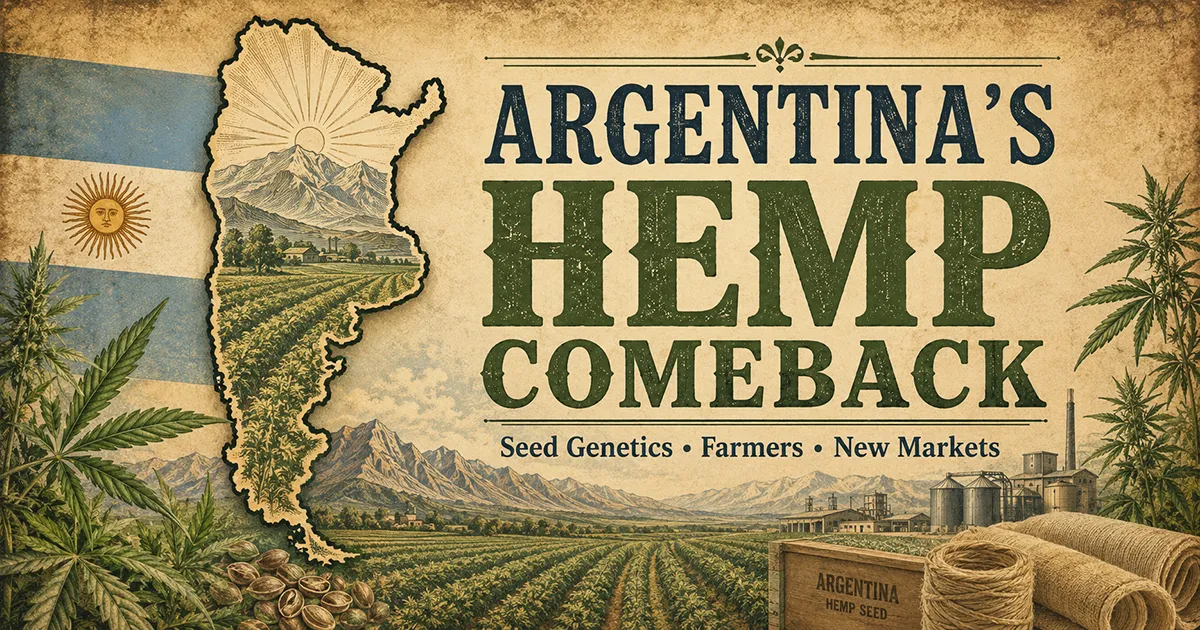
Argentina may become one of the most important proving grounds for the next phase of industrial hemp.
With deep agricultural experience, diverse growing regions, existing seed infrastructure, and renewed interest in hemp as a practical farm crop, Argentina offers something the global hemp industry badly needs: a place to build, test, and scale.
That was the central theme of a recent iHemp Hour conversation with Jeremy of Davis Farms and Santiago of Ananda Pampa. Their work in Argentina points to a larger question for farmers, processors, and policymakers: what happens when industrial hemp is treated as agriculture first?
“We are seeing industrial hemp as one more crop for our farmers. Period.”
— Santiago, Ananda Pampa
For Michigan farmers and hemp advocates, that sentence should land hard. In the United States, industrial hemp is still too often pulled into cannabis politics, THC anxiety, and regulatory confusion. In Argentina, the opportunity being described is more direct: hemp as a crop, hemp as a rotation option, hemp as seed production, hemp as fiber, hemp as grain, and hemp as a foundation for new industrial markets.
That does not mean the work is easy. It means the frame is different.
The Seed Problem Hemp Must Solve
Before industrial hemp can scale, farmers need confidence in the seed.
That may sound obvious, but it has been one of the biggest barriers in the industry. Hemp has been asked to move from prohibition-era genetics and unstable supply chains into modern agriculture almost overnight. That is not how commodity crops are built.
Jeremy put the issue plainly:
“If you don’t have good, stable, high-quality, certified, highly viable, reliable seed, you can’t build an industry.”
— Jeremy, Davis Farms
That one line may be the heart of the entire conversation.
Farmers do not need hype. They need seed they can trust. They need genetics suited to their region, their climate, their equipment, their end market, and their compliance requirements. If the seed is unreliable, everything downstream suffers: planting, stand establishment, harvest timing, THC compliance, processing, contracts, and farmer confidence.
Why Argentina Is Well Positioned
Argentina is not just another potential hemp market. It is already a serious agricultural country with a long history of growing, multiplying, cleaning, and exporting seed for major crops.
That matters because hemp needs more than a few trial plots. It needs the systems that support real agriculture.
In the conversation, Jeremy explained that Argentina has the scale, infrastructure, and agricultural knowledge to support seed multiplication for planting seed that can serve other regions, including the United States. Santiago also described Argentina’s productive agricultural regions, including La Pampa, as part of the country’s opportunity to show farmers that hemp can fit into real farming systems.
Santiago’s family background also brought the point home. He described his father, an 80-year-old farmer, seeing the hemp crop and recognizing that there was something meaningful there for Argentine agriculture.
That kind of response matters. When farmers who understand corn, soy, and traditional rotations look at hemp and see potential, the conversation changes.
Hemp Genetics Must Match the Purpose
One of the useful parts of this iHemp Hour discussion was the reminder that there is no single “hemp crop.”
Hemp grown for fiber is not the same as hemp grown for grain. Hemp bred for resin-based applications is not the same as hemp bred for long fiber, short fiber, seed production, or remediation. Even within fiber, different end uses can require different plant traits.
Jeremy described hemp as a highly nuanced plant with breeding lanes for:
- Fiber production
- Grain production
- Resin-based applications
- Dual-purpose crops
- Tri-purpose crops
- Remediation and other emerging uses
This is where hemp becomes more interesting than a single commodity. It is a platform crop. The opportunity is not one product. The opportunity is learning how to match genetics, agronomy, processing, and markets.
From Single-Use Crop to Biorefinery Model
A major theme in the conversation was the idea that hemp should not be viewed only through a single end use.
A farmer might grow hemp for fiber while also harvesting grain. Looking further ahead, the remaining plant material may contain compounds that can be extracted for additional value. That is the biorefinery model: use more of the plant, create more value streams, and reduce waste.
Jeremy described a future where dual-deck harvesting equipment could separate stalk material for fiber and seed heads for grain. He also discussed the potential for post-threshed material to support additional extraction opportunities.
That is a very different mindset from asking whether hemp is “fiber or grain or CBD.”
The better question is: how much of the plant can be used responsibly and profitably?
Beyond CBD: High-Value Compounds in Hemp
For years, the hemp conversation has been dominated by CBD. That made sense during the first wave of market development, but it also narrowed public understanding of the plant.
This episode pointed to a broader opportunity.
Jeremy discussed alpha-bisabolol, a terpene used in high-value cosmetic and anti-aging products. He explained that while the cosmetics industry commonly sources alpha-bisabolol from German chamomile, certain resin-based hemp genetics may offer another natural source.
That is a “wait, hemp can do that?” moment.
It also illustrates why the biorefinery model matters. Hemp contains cannabinoids, terpenes, fats, lipids, fiber, grain, protein, oil, and biomass. Some of these markets already exist outside the hemp industry. The challenge is not always creating a brand-new market. Sometimes the opportunity is supplying existing markets from a new agricultural source.
Watch the Full iHemp Hour Conversation
The full iHemp Hour conversation goes deeper into Argentina’s hemp history, Davis Farms and Ananda Pampa’s seed work, dual- and tri-crop opportunities, alpha-bisabolol, industrial processing, and what Michigan can learn from Argentina’s approach.
Watch the full episode below.
Argentina’s Hemp History Gives This Story More Weight
What makes the Argentina story especially compelling is that the country is not starting from zero.
Santiago shared the story of Don Julio Steverlynck, a Belgian immigrant who helped build a hemp and textile legacy in Argentina. His story connected hemp to farming, textiles, construction, worker housing, schools, family life, and community development.
That history gives today’s work a deeper meaning. This is not only about introducing a new crop. It is also about recovering a practical industrial crop that already had roots in the country.
Santiago described the opportunity as a bridge between the past and the present:
“We are joining the past with all the learnings that we have and also the present.”
— Santiago, Ananda Pampa
That is a powerful frame for hemp development. The goal is not nostalgia. The goal is to combine history, modern seed genetics, agricultural experience, and industrial infrastructure into something useful now.
An Industrial Park Built for Hemp Innovation
The discussion also highlighted an industrial park connected to Argentina’s hemp history. Davis Farms of Argentina and Ananda Pampa are working from a site with existing infrastructure, including offices, utilities, roads, textile capacity, industrial facilities, and nearby production land.
That matters because hemp does not scale on farming alone.
A crop needs a place to go. It needs cleaning, storage, processing, manufacturing, logistics, buyers, and policy support. Without that, farmers are left with risk and no market.
The Argentina project is interesting because it appears to bring several necessary pieces closer together:
- Seed production
- Agricultural land
- Fiber and textile history
- Industrial infrastructure
- Potential construction material applications
- Export logistics
- Supportive local conditions
Jeremy described the site as a place where technology and infrastructure could help accelerate hemp development while regulatory hurdles in the United States continue to slow progress.
A Better Way to Think About Regulation
One of the sharpest contrasts in the conversation was regulatory mindset.
In the United States, hemp policy is still shaped by the confusion left behind by prohibition. Industrial hemp can be pulled into debates about intoxicating products, cannabis regulation, and THC limits even when the product being discussed is fiber, grain, seed, building material, or industrial biomass.
That is why Santiago’s comment stood out:
“We are seeing industrial hemp as one more crop for our farmers. Period.”
— Santiago, Ananda Pampa
That mindset should matter to Michigan.
Michigan farmers do not need more confusion. They need practical rules, clear markets, reasonable costs, and a state and federal framework that lets industrial hemp function as agriculture.
A hemp fiber crop should not be treated the same way as a cannabinoid product. Hemp grain, hemp seed, hempcrete, textiles, animal bedding, biocomposites, and other industrial uses need rules that reflect what they are.
When regulation treats hemp as only a cannabis problem, it limits the crop before farmers and processors can prove what it can do.
What Michigan Can Learn from Argentina
The Argentina example is not a copy-and-paste model for Michigan. The climates, markets, regulations, and infrastructure are different.
But the lessons are very relevant.
Michigan needs the same kind of serious thinking if industrial hemp is going to move beyond pilot projects and scattered enthusiasm.
The biggest takeaways are clear:
- Reliable seed comes first. Farmers need viable, certified, traceable genetics that match their growing region and end market.
- Hemp needs real infrastructure. Processing, cleaning, storage, manufacturing, and logistics must develop alongside farming.
- End use matters. Fiber, grain, resin, seed, remediation, and building materials all require different production goals.
- The whole plant has value. The biorefinery model may be essential to making hemp more profitable and sustainable.
- Policy must match reality. Industrial hemp should be regulated as agriculture when it is being grown and used as agriculture.
- History can guide the future. Argentina’s hemp past shows that industrial hemp is not a fantasy crop. It has been used before, and it can be built again.
Hemp Is Bigger Than One Product
The most important lesson from this conversation is that hemp should not be reduced to a single product category.
It is not just CBD. It is not just fiber. It is not just grain. It is not just a policy debate.
Hemp is a crop with many possible uses, and those uses require different genetics, different markets, and different kinds of processing. That complexity can be frustrating, but it is also the source of hemp’s opportunity.
For Michigan, the challenge is to build the pieces in the right order: seed, farmers, research, processing, market development, and fair regulation.
For Argentina, the work now underway may help show what is possible when a major agricultural country treats hemp as a serious crop.
Why This Conversation Matters
The global hemp industry does not need more empty excitement. It needs examples of people doing the work.
That is what makes this iHemp Hour worth watching.
Jeremy and Santiago are not only talking about hemp’s future. They are working on seed production, genetics, field trials, infrastructure, and industrial market development in a country with the agricultural capacity to matter.
That should be encouraging to anyone who believes hemp still has a role to play in farming, materials, food, fiber, ingredients, and rural economic development.
Michigan should be paying attention.
Learn More About iHemp Michigan
iHemp Michigan exists to educate, inform, and promote the research, development, and cultivation of industrial hemp.
Through the iHemp Hour and our educational programs, we bring together farmers, processors, researchers, entrepreneurs, advocates, and policymakers to discuss the real opportunities and challenges facing the hemp industry.