Representatives from iHemp Michigan traveled to Lansing to testify before the Michigan Senate Regulatory Affairs Committee in support of Senate Bill 608 and Senate Bill 609, legislation intended to update Michigan’s industrial hemp laws.
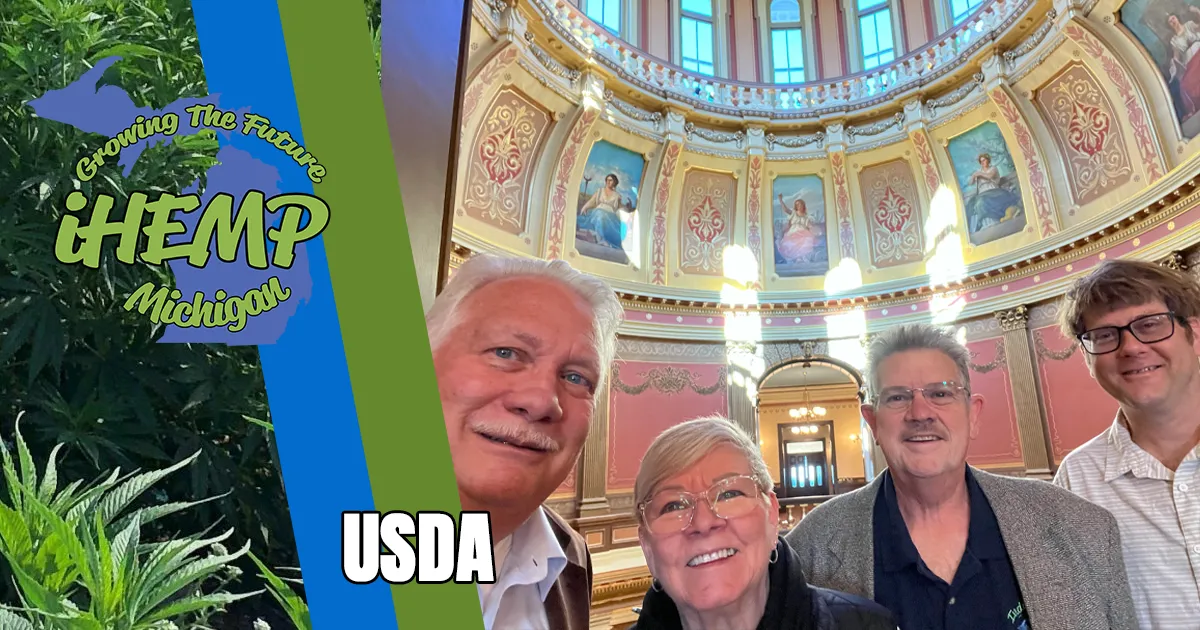
Representing iHemp were Dave Crabill, Blain Becktold, Becky Becktold, and Andrew Simons. Dave Crabill and Blain Becktold provided testimony during the hearing.
The purpose of our visit was simple: help lawmakers better understand that industrial hemp is not just about cannabinoids. Hemp is an agricultural crop with real potential in fiber, grain, food, seed, animal bedding, bioplastics, building materials, and other non-intoxicating uses.
Why We Went to Lansing
Michigan has an opportunity to build a stronger hemp economy, but uncertainty around hemp policy continues to hold the industry back.
Farmers, processors, manufacturers, retailers, banks, insurers, and investors all need clearer rules. Without that clarity, legitimate hemp businesses face unnecessary friction, even when their products are non-intoxicating and have nothing to do with marijuana.
One example shared during testimony involved a hemp Frisbee company. When a bank asks how much THC is in a Frisbee, it shows how deeply hemp confusion still affects ordinary business decisions.
That kind of question may sound funny at first, but it points to a serious problem. A non-consumable hemp product should be treated like other agricultural or manufactured products. Confusion around THC should not prevent normal access to banking, insurance, processing, or commerce.
A Lower Barrier for Michigan Farmers
One of the most practical benefits discussed during the hearing is the proposed move of Michigan’s hemp licensing program to the USDA. Both the Michigan Farm Bureau and the Michigan Department of Agriculture and Rural Development supported this move.
This change would significantly reduce the cost for farmers. Instead of paying $1,250 per year for a state hemp license, growers would be able to license through the USDA at $100 for three years.
That lower cost matters. It gives Michigan farmers a more realistic opportunity to experiment with small hemp grows, learn how the crop performs on their land, understand harvest and handling requirements, and decide whether hemp fiber or grain production can fit into their farm operation.
For an emerging crop like hemp, lower-cost entry is critical. Farmers should not have to make a large licensing investment before they have had a chance to learn the crop, test the market, and build confidence.
Molly Mott of MDARD reported that from a high of 685 growers in 2019, we have 25 growers in 2025. The risk has been too high.
A Serious Question About Banking
Senator Sam Singh asked an important question about banking. That question opened the door to explain one of the biggest barriers facing hemp entrepreneurs.
Even after the 2018 Farm Bill legalized hemp federally, many businesses still deal with added scrutiny from banks, payment processors, and service providers. This is especially frustrating for companies working with hemp fiber, hemp grain, or other non-intoxicating products.
Banking access is not just a cannabis issue. It is also an industrial hemp issue.
When banks, insurers, and lenders are unsure how to evaluate hemp products, they often avoid the category altogether. That slows investment, limits processing infrastructure, and makes it harder for Michigan farmers and manufacturers to participate in the growing hemp economy.
Moving Beyond the Old Hemp Jokes
Senator Sean McCann asked whether the hemp Frisbees “fly higher.” The comment got a laugh, and we understand the humor.
But that moment also showed why education is still needed.
For decades, hemp has been treated as a punchline or confused with intoxicating cannabis products. That stigma still follows farmers and businesses trying to develop useful, non-intoxicating products from the hemp plant.
The future of industrial hemp depends on helping the public and policymakers clearly distinguish between intoxicating products and legitimate industrial hemp uses.
The Market Opportunity Is Real
The potential for hemp grain and fiber is much larger than many people realize.
Whitney Economics previously projected that U.S. hemp grain and fiber demand could support 5.5 million acres by 2030, but later reduced that forecast to 1 million acres because of regulatory uncertainty, lack of infrastructure, and federal policy risk. That reduction represents roughly $3.1 billion in reduced projected revenue for American farmers.
That is exactly why clear state policy matters.
Michigan should not be on the sidelines while other states build hemp processing, manufacturing, and supply chain infrastructure. With the right rules, Michigan farmers and businesses can participate in markets for hemp foods, grain, fiber, textiles, animal bedding, erosion-control products, bioplastics, and hemp-lime building materials.
The Outcome
The testimony was well received, and there appears to be strong interest in moving the bills forward. We were encouraged by the thoughtful questions from committee members and by the recognition that Michigan’s hemp laws need to better support legitimate industrial hemp activity.
Support from the Michigan Farm Bureau and the Michigan Department of Agriculture and Rural Development for moving hemp licensing to the USDA was especially important. Reducing the licensing burden from $1,250 per year to $100 for three years would make it much easier for farmers to try small hemp grows and gain real-world experience with the crop.
Senate Bill 608 and Senate Bill 609 are not the final step. More work will be needed to educate policymakers, regulators, financial institutions, farmers, and the public.
But today was a positive step.
iHemp Michigan will continue working to ensure that Michigan’s hemp farmers, processors, manufacturers, and entrepreneurs have a fair opportunity to build this industry.
Thank You
We appreciate Senator Lauwers, Senator Cherry, Chair Jeremy Moss, Senator Singh, Senator McCann, and the members of the Senate Regulatory Affairs Committee for giving industrial hemp serious consideration.
We also appreciate the Michigan Farm Bureau and the Michigan Department of Agriculture and Rural Development for recognizing the importance of reducing barriers for farmers and supporting a clearer path forward for industrial hemp in Michigan.
Michigan has the land, talent, agricultural history, and manufacturing strength to be a leader in industrial hemp. Clear policy is how we get there.