The Grostic Farm Story—and a Path Forward for Michigan
A farm, a shutdown, and a farmer who wouldn’t quit
In Livingston County, Michigan, a family farm became ground zero for a problem too many communities are facing but few feel so personally: PFAS—“forever chemicals”—in the soil and water. When state officials asked Jason Grostic to voluntarily allow soil testing on his cattle farm, he said yes. The results—roughly 50 parts per billion in the soil—led to a devastating order: shut down.
Like many farmers, Jason had used municipal wastewater sludge (“biosolids”) to enrich his fields. He followed the same practices used across the state. Yet after cooperating in good faith, his farm was the one closed. His livelihood vanished overnight.
Jason’s journey: after “closed,” he chose “learn and act”
For decades, the Grostic family lived and worked on this land. They grew and ate food from the farm and fed surrounding families. Learning that PFAS had touched the soil and water was shocking and heartbreaking—a deep wound to the trust they’d built with neighbors and to the pride they took in stewarding safe, healthy land.
Jason did what he’s always done: he went to work. He dug into the science and into solutions other states were trying. In Maine, he found a practical path: farms with elevated PFAS can stay in production by switching to lower-uptake crops (fruits, seeds, and grains tend to accumulate less) while mitigation and long-term cleanup proceed. He appealed to Michigan to let him follow that model—plant safe crops, keep the land alive, protect the community. He was denied.
Adding insult to injury, the state still allowed public hunting on the property. Worried about what hunters might be taking home, Jason tested wildlife. The results hit like a second punch: deer and game carried higher PFAS levels than his cattle ever did. The contamination wasn’t just a “farm” problem. It was an ecosystem problem.
In the midst of this ordeal, Jason suffered a heart attack. It was a jarring reminder that PFAS isn’t only about chemistry—it’s also about people: the stress of losing a livelihood, the uncertainty of what’s safe to eat, and the health stakes that now shadow daily life. Even then, Jason made a choice: if he couldn’t raise cattle today, he would raise answers—for himself and for every farmer who might face the same fight.
“When they closed my farm, they didn’t close my responsibility to my community. If we can figure out how to fix this—here, on real ground—maybe other families won’t go through what mine did.”
— Jason Grostic
Health note: PFAS, cholesterol, and why vigilance matters
Jason lived and ate from this land for decades—meaning chronic, cumulative exposure, not a one-time event. The best evidence links PFAS exposure with higher total and LDL cholesterol, a major cardiac risk factor. While no one can say PFAS alone caused his heart attack, it likely added to his cardiovascular burden. For Jason—and any PFAS-affected farmer—regular lipid panels and routine heart-health follow-up are prudent, protective steps while the land is being remediated.
CARE FOR PEOPLE WHILE WE FIX THE SOIL
• Talk with your clinician about a lipid panel and routine cardiovascular risk checks if you live or work in a PFAS-affected area.
• Safe food guidance and crop choices help—but so does preventive care for the people doing the work.
Turning “forever” into “manageable”: hemp, fungi, and microbes
PFAS are stubborn: they don’t break down easily, move with water, and accumulate in living things. Conventional approaches—digging up soil, washing it, shipping waste—are expensive, disruptive, and often just move the problem. That’s why Grostic Farms is becoming a living lab for nature-based remediation, stacking hemp, fungi, and beneficial microbes to capture and contain PFAS where they are, then pairing the harvest with safe destruction methods.
How the system works—plainly
1) Hemp captures.
Industrial hemp grows fast, sends down deep roots, and produces abundant biomass. Certain PFAS compounds can bind to roots or move into plant tissues, letting us pull contamination upward from critical topsoil layers—if we harvest and handle plants correctly.
2) Fungi and microbes assist.
• Mycorrhizal fungi weave microscopic threads through soil, effectively extending the plant’s root system. This increases contact with contaminated porewater and creates tiny zones where PFAS can biosorb to biofilms and fungal cell walls, reducing mobility.
• Beneficial bacteria and soil microbes keep roots healthy, build stable soil aggregates, and shift pH and redox conditions—all of which can change how PFAS partition between water, soil, and living matter. The goal is to hold PFAS where plants and engineered sorbents can reach them, not let them run off in storms.
3) Harvest—and destroy.
Phytoremediation only “works” if captured PFAS are neutralized. Post-harvest pathways (e.g., hydrothermal liquefaction or similar thermal/chemical processes) can concentrate and reduce PFAS under controlled conditions. Capture + destruction turns “forever” into manageable.
WHY HEMP HERE?
• Deep roots, fast biomass, resilient in varied soils
• Pairs naturally with fungal networks and microbial consortia
• Compatible with a “harvest & destroy” endgame that closes the loop
The team on the ground—and across the ocean
This isn’t a solo effort. Jason has opened his gates to a coalition of farmers, scientists, and problem-solvers:
• Cody Ley of Hemp 4 Humanity, bringing hands-on hemp-building experience and a passion for affordable, sustainable solutions.
• Micronaut: Ryan Iacovacci (CEO) and Joe Lane (Chief Mycologist), designing fungal and microbial consortia to stabilize soils and support plant performance.
• Cole Stefl of MicrobialMud, focusing on rhizosphere microbiology and field-ready bio-inputs that build resilient soil life.
• IND HEMP (Montana): Rusty Peterson—a long-time iHemp Michigan member—supporting agronomy, fiber logistics, and real-world hemp supply chain know-how.
The Belgium connection: science that travels
PFAS isn’t just Michigan’s problem. It’s global. In Belgium’s Flanders region, communities around industrial hotspots have launched hemp-centered pilots that blend plants, fungi, and engineered biology—on real sites, not just in labs.
From that front line came a powerful show of solidarity: Ingmar Nopens of C-Biotech—a bioengineer and leader in nature-based PFAS remediation—flew in from Belgium to attend the Grostic Farms event. His presence underscores a simple truth: farmers and scientists are on the same side, and the best ideas should cross borders as fast as PFAS did.
What Maine learned—and how farms keep producing safely
Maine traced much of its farm contamination to decades of sludge/biosolids land-application, then stood up a farm-by-farm response to test soils, water, forage, and products. Instead of blanket shutdowns, they paired action levels for milk and meat with mitigation plans: treat water, re-route feed, and—critically—switch crops on impacted fields.
The big pattern: PFAS uptake tends to be higher in leafy/stem tissues and lower in fruits, seeds, and mature grains. So Maine’s practical playbook is to shift production from hay/leafy greens toward grain corn, small grains (oats/wheat), and fruiting crops (tomatoes, cucumbers, melons) on fields that test elevated. Leafy greens and dairy forage move to clean land or protected production; beef can depurate on clean rations with planned timelines; dairy requires especially tight control of feed and water.
Jason asked Michigan for this common-sense flexibility: let him plant lower-uptake crops to keep the land productive while remediation research proceeds. He was denied. Maine shows there’s a workable alternative that safeguards both public health and farm livelihoods.
WHAT MAINE TEACHES US
1. Map and manage: test by field, tailor the plan, keep clean supply chains.
2. Switch the crop mix: move off leafy/forage on impacted land; lean on grains and fruiting crops.
3. Keep people in business while science and cleanup catch up.
The Michigan problem we can actually fix: policy
Right when Michigan needs more pilot plots and partnerships, our rules make research needlessly risky and expensive:
• $1,350 to grow hemp for any purpose—including research.
• $500+ in testing fees, with a sampling practice that often targets only the tops of plants (where THC concentrates), even for fiber and grain varieties with no intoxicating use.
• If a field drifts slightly above 0.3% THC—due to weather, stress, or normal variance—the farmer must destroy the entire crop. No safety net. No compensation.
This isn’t how you treat a crop that can help clean soil, rebuild rural economies, and reduce risk for communities. It’s how you smother innovation.
A workable path forward
• Move Michigan’s hemp program under the USDA for consistent, research-ready rules.
• Create a national set-aside for fiber and grain hemp so farmers aren’t bankrupted by tiny THC fluctuations in non-intoxicating crops.
• Fund the harvest-and-destroy infrastructure (e.g., hydrothermal processes) that turns captured PFAS into a closed-loop solution.
• Adopt a Maine-style farm playbook in PFAS zones: crop flexibility, clear action levels, and on-farm mitigation plans that keep safe production going.
Why this matters now
Because Jason’s heart attack and his family’s history on this land remind us that PFAS isn’t only about chemistry—it’s about health, heritage, and trust. Because hunters and families deserve to believe in the land they walk and the food they bring home. Because the people paying the highest price are rarely the ones who created the problem. And because a farmer who lost his cattle still chose to host the science that could help his neighbors.
Jason didn’t pick this fight. But he’s standing in it—with an open gate and open books—so others don’t have to lose what he lost.
Join the fight to free hemp—and protect farmers
At iHemp Michigan, we’re here to turn frustration into policy, and heartbreak into a plan. We’re here to help farmers plant solutions, not just crops. And we’re here to make sure the rules enable the research Michigan needs—not block it.
If Jason’s story moved you, help us move the system.
Become a member today: Join
Together, we can free hemp, support our farmers, and protect our land. 🌱💧🐄
Ending on a Positive Note!
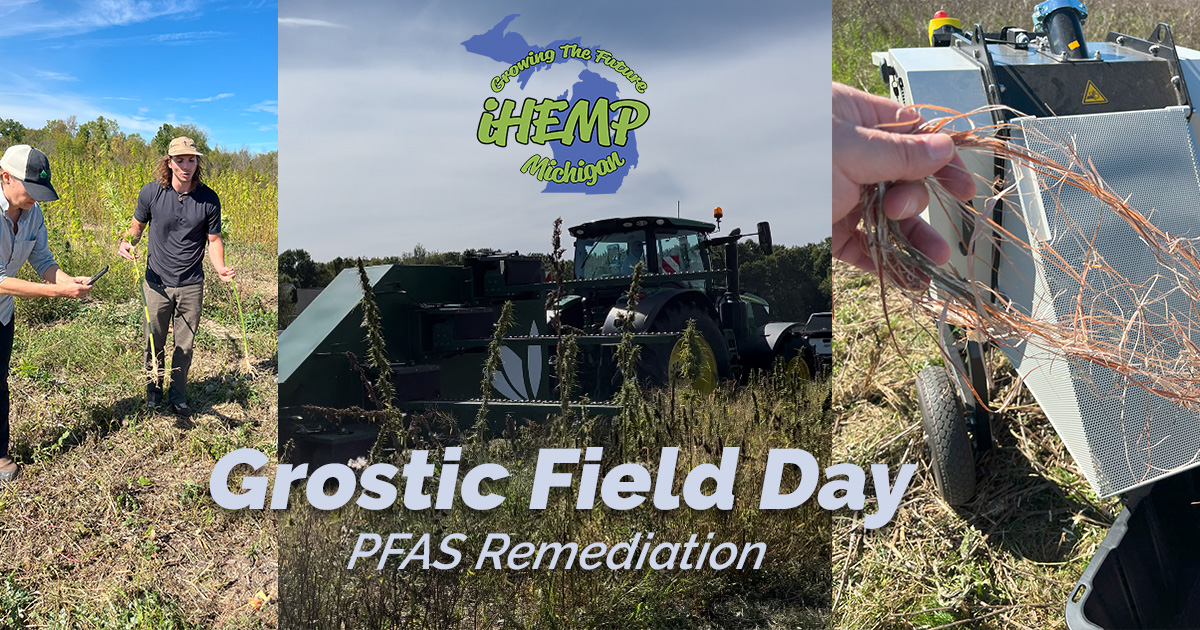
One of our great board members was on hand to demonstrate her new decorticator! Robbin Pott of Pott Farms worked tirelessly to get the European electrical system configured to a three-phase generator. The decorticator arrived at her farm just prior to our last event, but required three different electritions to sort out the power connection and get it operational.
We now have a working Hurd Master decorticator in Michigan, huge news! Contact Robbin if you want to use it on your farm. It and the generator fit nicely on a trailer for mobile service. Now we need more fiber plots to learn from!
Pott Farms is located at 12280 Bunton Rd, Willis, Michigan, 48191. You can reach Robbin Pott at 734-904-2126.